Partners

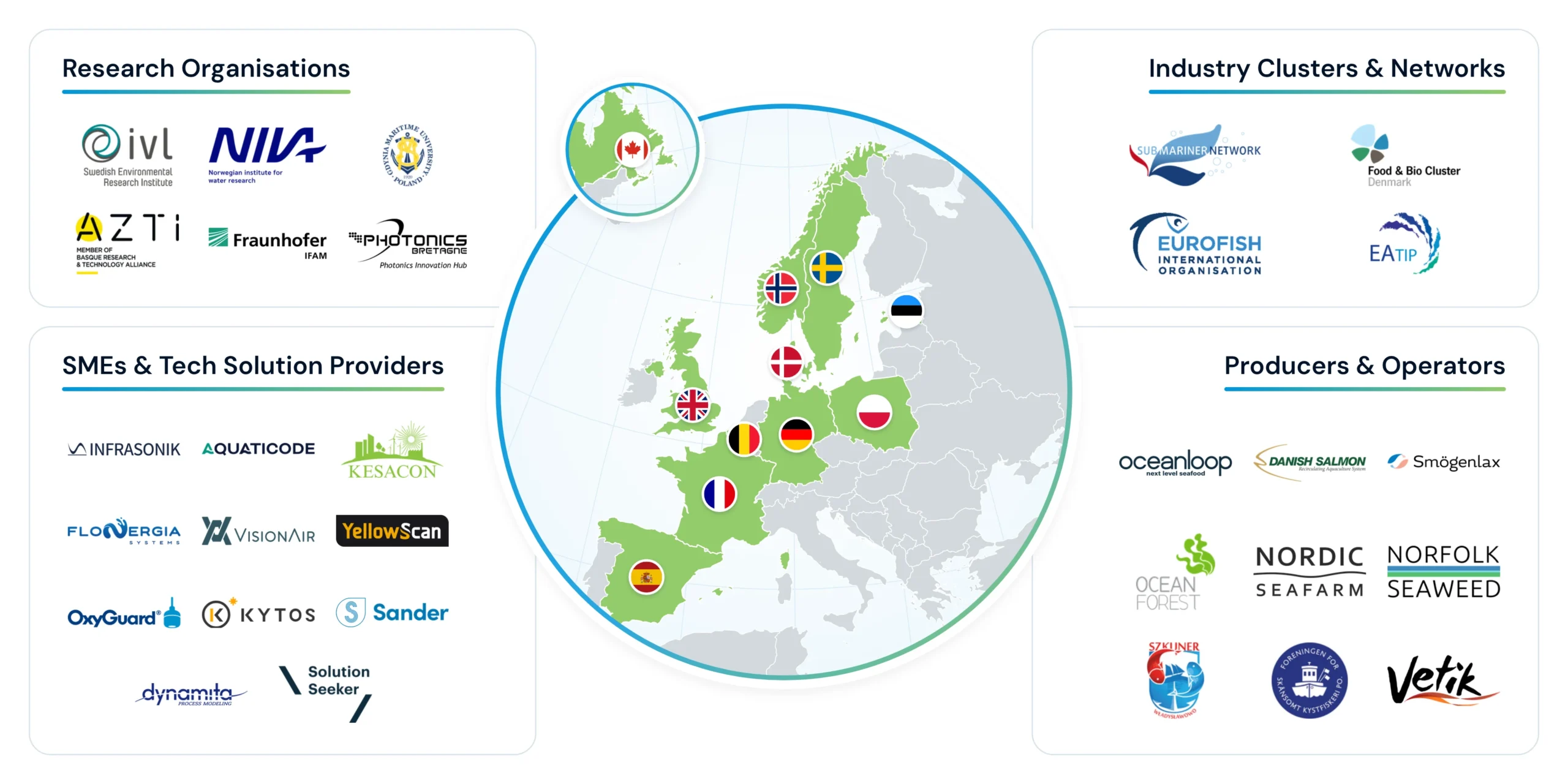
SEADEEP is a consortium of 30 partners from 11 countries, coordinated by IVL Swedish Environmental Research Institute.

THE CONSORTIUM

30 partners, 11 countries

Research institutes, technology developers, producers, industry networks and intergovernmental organisations from Sweden, Norway, Denmark, Germany, Poland, Estonia, Belgium, France, Spain, the United Kingdom and Canada.

Map of the SEADEEP consortium: partner logos grouped into research organisations, industry clusters and networks, SMEs and tech solution providers, and producers and operators, around a map of partner countries

WHO IS INVOLVED

Partner Information

IVL Swedish Environmental Research Institute logo

Country: Sweden  |  Website: www.ivl.se

IVL is a leading Swedish Environmental Research Institute, with deep expertise in environmental monitoring, sustainability science and life-cycle assessment. As project coordinator, IVL steers SEADEEP and leads the macroalgae demonstration work package. They also guide the project’s impact assessment and the site-specific modelling that adapts SEADEEP’s solutions to conditions across the North and Baltic Seas.

Role in the project: Leads WP7 Project Coordination and WP2 Macroalgae, and contributes to WP1 RAS.

Fraunhofer IFAM logo

Country: Germany  |  Website: www.fraunhofer.de

Fraunhofer is one of Europe’s largest applied research organisations. In SEADEEP they lead the recirculating aquaculture (RAS) demonstration work package and build the project’s digital backbone: the shared data architecture, the common KPI and ESG framework, and the baseline models against which energy and emissions savings are measured.

Role in the project: Leads WP1 RAS and builds the project’s digital backbone (data architecture, KPI and ESG framework, baseline models).

NIVA logo

Country: Norway  |  Website: www.niva.no

NIVA, the Norwegian Institute for Water Research, brings long-standing expertise in water quality and aquatic ecosystem health. They help develop SEADEEP’s RAS digital backbone and baseline digital twins, support site-specific modelling, and lead the scientific interpretation and publication of project results.

Role in the project: WP1 RAS. Contributes to the digital backbone and baseline digital twins, supports site-specific modelling, and leads the scientific interpretation and publication of results.

Gdynia Maritime University logo

Country: Poland  |  Website: www.umg.edu.pl

Gdynia Maritime University contributes expertise in artificial intelligence, data analytics and maritime engineering. They lead the SmartFleet work package, developing AI and IoT tools that monitor energy use and support decarbonisation decisions for small-scale fishing fleets.

Role in the project: Leads WP3 Fisheries SmartFleet.

SUBMARINER Network logo

Country: Germany  |  Website: www.submariner-network.eu

The SUBMARINER Network is a unique platform that brings actors from the whole Baltic Sea Region together to actively promote innovative and sustainable use of marine resources. It operates across the whole knowledge triangle (research, education, and innovation) integrating perspectives from local to international scales, different scientific disciplines as well as policy and economic stakeholders. In SEADEEP they lead communication, dissemination and capacity building.

Role in the project: Leads WP5 Communication and Dissemination, including capacity building, management of the multi-actor approach and stakeholder engagement.

Food & Bio Cluster Denmark logo

Country: Denmark  |  Website: www.foodbiocluster.dk

Food & Bio Cluster Denmark links companies, researchers and public bodies across the food and bio sectors, with particular strength in business modelling and industry uptake. They lead the work package on market uptake and exploitation, helping turn SEADEEP’s demonstrations into viable products and lasting industry practice.

Role in the project: Leads WP6 Market Uptake and Exploitation.

Eurofish International Organisation logo

Country: Denmark  |  Website: www.eurofish.dk

Eurofish is an intergovernmental organisation that supports the development of fisheries and aquaculture across Europe. They lead the work package on impact evaluation and business-model optimisation, and draw on their international network to engage stakeholders, raise awareness and keep the project aligned with EU and national regulation.

Role in the project: Leads WP4 Impact Evaluation and Business Models, and supports stakeholder engagement.

EATiP logo

Country: Belgium  |  Website: www.eatip.eu

EATiP promotes and supports research and innovation for sustainable European aquaculture. A not-for-profit quadruple helix membership platform, EATiP connects the aquaculture industry with research and policymaking. In SEADEEP EATiP supports communication, exploitation, policy recommendations and broad stakeholder engagement.

Role in the project: WP6 Market Uptake and Exploitation. Supports communication, policy recommendations and stakeholder engagement.

Photonics Bretagne logo

Country: France  |  Website: www.photonics-bretagne.com

Photonics Bretagne is a photonics technology centre. For SEADEEP they adapt their reflectance-spectroscopy leaf-clip sensor, already used in agriculture, to measure nitrogen directly in fresh macroalgae, giving cultivators a fast, non-destructive way to monitor crop condition.

Role in the project: WP2 Macroalgae. Technology provider of a non-destructive nitrogen sensor for fresh biomass.

AZTI logo

Country: Spain  |  Website: www.azti.es

AZTI is a Spanish marine and food research centre with extensive expertise in sustainable fisheries, digitalisation and blue economy solutions. In SEADEEP, AZTI provides energy-monitoring know-how, fisheries data and technical expertise to support the SmartFleet demonstrator and the deployment of low-emission digital solutions for small-scale fishing vessels.

Role in the project: WP3 Fisheries SmartFleet. Supports the demonstrator with energy-monitoring know-how, fisheries data and technical expertise.

Oceanloop logo

Country: Germany  |  Website: www.oceanloop.com

Oceanloop develops and operates land-based recirculating aquaculture systems (RAS). They lead the flagship demonstration of a next-generation, energy-efficient RAS facility for Giant grouper built on their Energy Transition Hub concept, serving as SEADEEP’s primary RAS living lab in Germany.

Role in the project: WP1 RAS. Leads the flagship demonstration and hosts the primary living lab in Germany.

Smögenlax logo

Country: Sweden  |  Website: www.smogenlax.se

SmögenLax runs a land-based salmon RAS farm in Sweden. They host a demonstration and replication site, including a digital twin of their water-treatment system, to test how well SEADEEP’s RAS innovations scale under real commercial conditions.

Role in the project: WP1 RAS. Demonstration and replication site in Sweden.

Danish Salmon logo

Country: Denmark  |  Website: www.danishsalmon.dk

Danish Salmon is a land-based salmon RAS producer. They provide a demonstration site in Denmark and share real production data, including growth and ESG data, that feed the project’s models and validation work.

Role in the project: WP1 RAS. Demonstration site in Denmark and provider of production and ESG data.

Ocean Forest logo

Country: Norway  |  Website: www.leroyseafood.com

Ocean Forest, part of the Lerøy group, practises integrated multi-trophic aquaculture in Norway, combining sugar kelp and blue mussels and reusing nutrients from nearby salmon farms. They provide one of SEADEEP’s macroalgae demonstration sites.

Role in the project: WP2 Macroalgae. Demonstration site in Norway.

Nordic SeaFarm logo

Country: Sweden  |  Website: www.nordicseafarm.com

Nordic SeaFarm operates one of Sweden’s largest seaweed farms, growing sugar kelp and sea lettuce under organic certification. They host the low-emission macroalgae drying demonstration and pilots for macroalgae monitoring.

Role in the project: WP2 Macroalgae. Host of the low-emission drying demonstration and monitoring pilots.

Norfolk Seaweed logo

Country: United Kingdom  |  Website: www.norfolkseaweed.com

Norfolk Seaweed has an offshore, regenerative sugar kelp farm in the Southern North Sea using low-input cultivation. They provide a macroalgae demonstration site and biomass samples that support the development of new optical sensors.

Role in the project: WP2 Macroalgae. Demonstration site and provider of biomass samples for sensor development.

Vetik logo

Country: Estonia  |  Website: www.vetik.eu

Vetik wild harvests local red seaweed and develops marine bioproducts in Estonia. They have started cultivation experiments in the Baltic Sea and provide a macroalgae demonstration site for monitoring.

Role in the project: WP2 Macroalgae. Demonstration site for monitoring in Estonia.

Aquaticode logo

Country: Norway  |  Website: www.aquaticode.com

Aquaticode develops artificial intelligence for aquaculture, combining advanced imaging and machine learning to phenotype individual fish and identify traits related to health, welfare, and production. In SEADEEP, the company will demonstrate a platform that combines conventional camera imaging with ultrasound to assess individual fish health and welfare.

Role in the project: WP1 RAS. Technology provider of a camera and ultrasound platform for fish health and welfare assessment.

OxyGuard logo

Country: Denmark  |  Website: www.oxyguard.dk

OxyGuard supplies monitoring, control and digital AI-based solutions for aquaculture, including water quality sensors and full facility control systems. In SEADEEP, OxyGuard contributes sensor and control systems, ESG automation, and AI-based fish behaviour and welfare monitoring integrated into its Cobália farm management system.

Role in the project: WP1 RAS. Technology provider of sensors, control systems, ESG automation and AI-based fish welfare monitoring.

Kesacon logo

Country: Sweden  |  Website: website to be confirmed

Kesacon develops energy-efficient heat-pump technology. They lead the integration of a high-efficiency heat-pump system for the low-emission macroalgae drying demonstration.

Role in the project: WP2 Macroalgae. Leads the heat-pump integration for the low-emission drying demonstration.

Infrasonik logo

Country: Sweden  |  Website: www.infrasonik.se

Infrasonik develops infrasound technology. They provide their infrasound-assisted drying system, the Pulsator, for macroalgae, raising throughput and energy efficiency while helping preserve the pigments and proteins in the crop.

Role in the project: WP2 Macroalgae. Technology provider of infrasound-assisted drying (the Pulsator).

VisionAir logo

Country: Sweden  |  Website: www.visionair.se

VisionAir provides integrated drone and LiDAR monitoring. For SEADEEP they deliver bathymetric LiDAR and drone surveys with automated processing for biomass measurement, vegetation prediction and water monitoring.

Role in the project: WP2 Macroalgae. Technology provider of drone and bathymetric LiDAR surveys.

YellowScan logo

Country: France  |  Website: www.yellowscan.com

YellowScan manufactures LiDAR systems. In SEADEEP they adapt their LiDAR with dedicated optical components for surveying in and around water, supporting macroalgae monitoring.
Role in the project: WP2 Macroalgae. Technology provider of LiDAR adapted for surveying in and around water.

Sander logo

Country: Germany  |  Website: www.aqua-sander.de/en

Sander develops and manufactures aquaculture technology for RAS operations. They supply automation, monitoring, controlling, and energy saving solutions for the German demonstration site.

Role in the project: WP1 RAS. Technology provider of automation, monitoring and energy-saving solutions for the German demonstration site.

Kytos logo

Country: Belgium  |  Website: www.kytos.be

Kytos specialises in microbiome management. In SEADEEP they deploy rapid, cytometry-based microbiome fingerprinting to measure and manage microbial conditions in RAS water and biofilters, keeping systems stable and reducing disease and performance risks.

Role in the project: WP1 RAS. Technology provider of microbiome monitoring for process water and biofilters.

Dynamita logo

Country: France  |  Website: www.dynamita.com

Dynamita develops process-modelling software, best known for its SUMO platform. They build a full digital twin of a RAS facility so operators can optimise energy and resource use through mechanistic modelling.

Role in the project: WP1 RAS. Technology provider of a full-facility digital twin.

Flonergia Systems logo

Country: Canada  |  Website: www.flonergia.com

FloNergia Systems Inc. is a Canadian water-technology company developing next-generation solutions for energy-efficient water movement and aeration. Its patented FloMov™ airlift pump technology integrates water circulation and aeration into a single, highly efficient system. Combined with intelligent sensing and AI-driven control, FloNergia’s technology significantly reduces the energy required to move water while enabling smarter, more sustainable aquaculture, agriculture, and water-treatment operations.

Role in the project: WP1 RAS. Technology provider of energy-efficient water movement and aeration (FloMov™ airlift pump).

Solution Seeker logo

Country: Norway  |  Website: www.solutionseeker.no

Solution Seeker is a leading provider of real-time production optimisation technology. It was founded in 2013 as a spin-off from the Norwegian University of Science and Technology (NTNU). With headquarters in Oslo and offices in Bergen, Rio de Janeiro and Perth, it leverages advanced AI and data-driven methods to solve real-world customer challenges across diverse industries. In SEADEEP they demonstrate AI-driven batch optimisation at the Oceanloop RAS site.

Role in the project: WP1 RAS. Technology provider of AI-driven batch optimisation at the Oceanloop site.

Szkuner logo

Country: Poland  |  Website: www.szkuner.pl

Szkuner operates Poland’s largest fishing port at Władysławowo, with Baltic fishing vessels, certified shipyard facilities and offshore wind logistics. They provide a small-scale fisheries demonstration, including fuel monitoring on working vessels.

Role in the project: WP3 Fisheries SmartFleet. Demonstration site in Poland, including fuel monitoring on working vessels.

Foreningen for Skånsomt Kystfiskeri logo

Country: Denmark  |  Website: www.skaansomtkystfiskeri.dk

FSK-PO is a producer organisation of small-scale Danish coastal fishers who use low-impact methods, and they manage the NaturSkånsom eco-label. They provide a small-scale fisheries demonstration and represent the wild-capture sector in the project.

Role in the project: WP3 Fisheries SmartFleet. Demonstration site in Denmark and representative of the wild-capture sector.

Want to work with SEADEEP?

Join the SUBMARINER working groups or register on BlueBioMatch to connect with the consortium.